My View from the Pew
On the fourth Sunday of Lent, I surveyed the sanctuary from a different vantage point during the sermon. Usually on Sundays, you can find me on the third row of the choir loft, where I can see the faces of most folks in the pews, but not the face of the preacher. On the morning in question, the handbell ensemble was scheduled to play in the balcony immediately after the sermon, so I needed to exit the choir loft early to be properly positioned to ring bells F5 and G5.
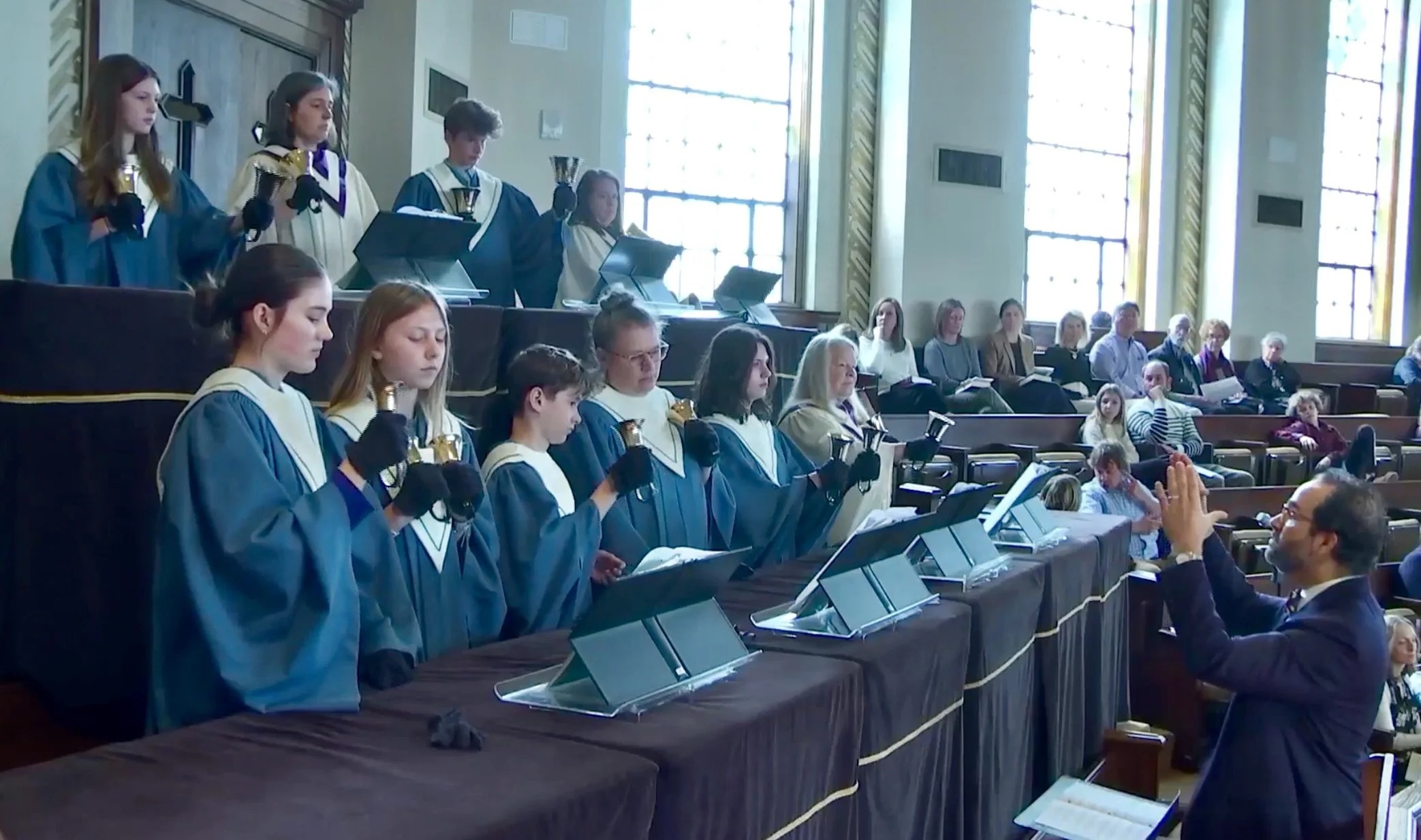
As the pastor began to preach, I took stock of my new surroundings. This section of the balcony is the one area of the sanctuary I cannot see clearly from my chair in the choir loft – the place where most of the young families in our congregation choose to sit week after week.
When I glanced down at the child sitting on the row in front of me, I noticed he was writing on a lined notepad. At the top of the page, he had written “Choklat Factery.” Now he had my attention. I continued discreetly reading over his shoulder: “In a factery, you can make many things – toys, candy, tols, and some houses. Today our factery is making choklat. Milk choklat.”
I assume “tols” meant “tools.” The story would have been significantly less interesting to me if the child’s imaginary factory had been making tools instead of milk chocolate. Although I couldn’t clearly read the bottom half of the page, the young writer appeared to be recording a recipe for how to make milk “choklat.”
After a few moments, the child passed his notepad to his older sister to read. She nodded with appreciation. Next, he handed his literary work to his father, who smiled and whispered words of affirmation. The child then flipped to the next blank page in his pad and began a new story: “All About Dogs.”
By this point, I had totally lost the thread of the sermon. I looked around the sanctuary. Underneath a stained-glass window, a boy was reading a book. Near the sound board, a little girl was busy creating a work of art with colored pencils. I smiled at these sights. I did not expect these children to be sitting still, hands demurely folded in their laps, listening intently as the pastor delivered the sermon. After all, that would be expecting them to do what many of the adults in the pews could not. (I see you nodding off, sir.)
Side note: A highlight of one my trips to Haiti was worshipping alongside our Haitian sisters and brothers. As was customary in that congregation, adults and children sat with their Sunday School classes during the worship service. This meant that children spent the nearly 2-hour service under the watchful eyes of teachers, not parents or grandparents. If a child misbehaved, their teacher might send them to sit on the platform beside the pastor’s wife for the duration of the service. Because I was seated on the platform on the opposite side of the pastor’s wife from that penalty box, I was able to witness a layperson carrying out an unusual ministry during worship: Rousing sleepers from their slumber during the sermon with a sharp tap on the shoulder.
Surveying the scene under the dome of our sanctuary, I wondered what each worshipper might be thinking. I recalled a photo a faculty member created to tease my father early in his career as a college administrator. In that embellished image of a faculty workshop, my father is speaking at a podium while his colleagues are absorbed in their own thoughts.
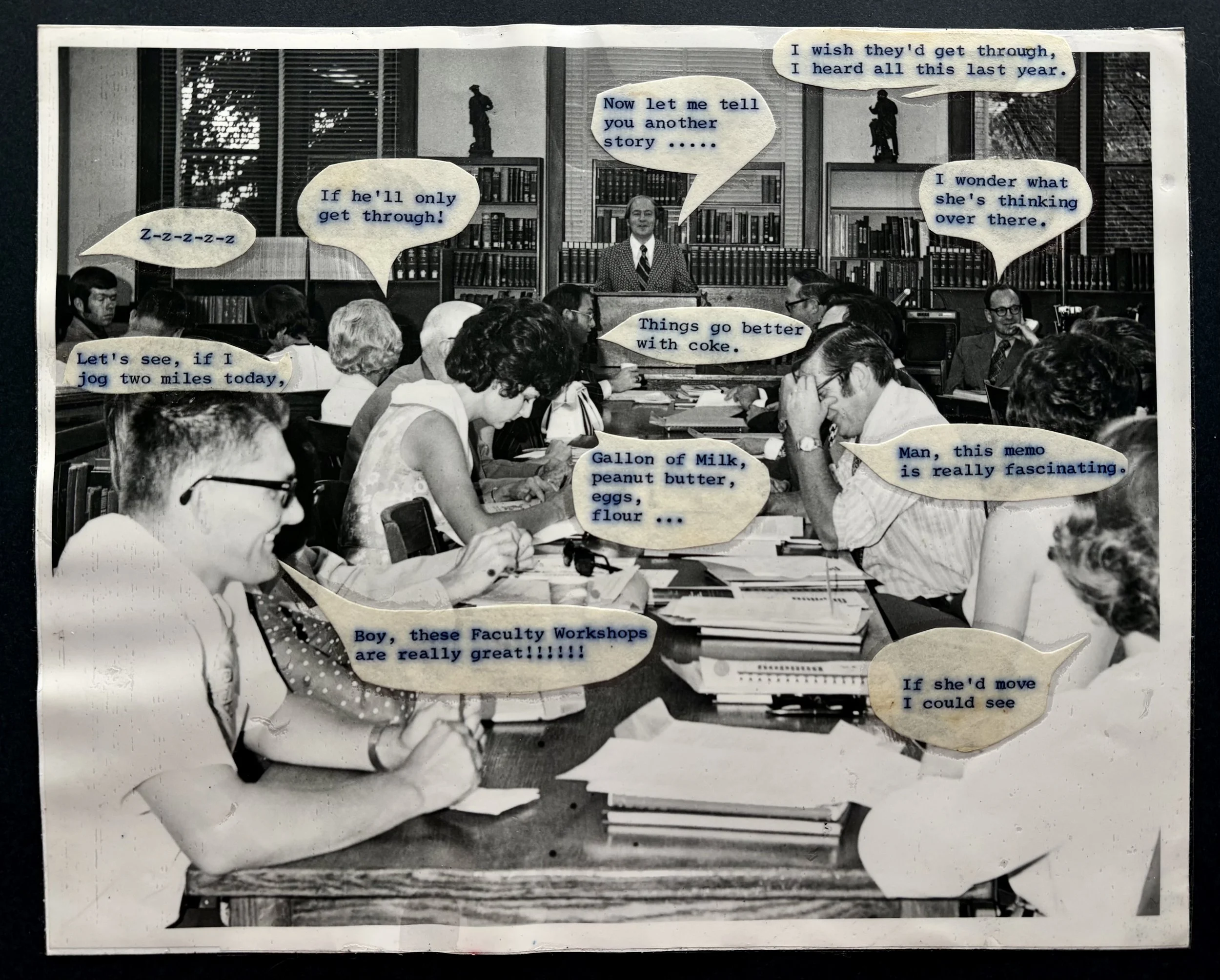
If thought bubbles were to pop up above the heads of every worshipper in our sanctuary, what would be revealed? Who is laser-focused on the sermon? Who is distracted? Who is pondering the implications of a recent diagnosis? Who is grieving the loss of a loved one? Who is weighed down by financial troubles? Who wishes we had sung a different hymn? Who is wondering what they will eat for lunch? Who is utterly exhausted from the sheer effort required to get their children dressed and transported to church?
As the oldest of four children born in less than five years, I am well acquainted with the challenge parents and grandparents face on Sunday mornings. Simply getting a child into the church building requires fortitude and patience. I have absolutely no desire to criticize families who choose to be elsewhere on Sunday mornings. The lives of the young families I know are far more complicated than mine was in that season of life. I also know that the church building is not the only place where a child’s spiritual life is nurtured.
From my experience serving as an associate pastor, I recognize how easy it is for ministers to focus their attention on the members of the flock who aren’t visible in the sheep pen on a Sunday morning. (I once heard a pastor lament that he could see “too much wood” in the pews.) Some pastors go as far as to openly joke during Christmas Eve and Easter Sunday services about attendees who are making rare church appearances. How does humiliating someone who has chosen to come and worship encourage them to attend more regularly?
Instead of focusing on the empty seats, I gradually learned to shift my attention to the people who were present in the pews. If I noticed someone nodding off while I preached, I didn’t take it personally. If a child was playing with a fidget or coloring or reading during the service, I was simply grateful for their presence among us. Surely the Spirit of the Lord was in that place. Surely the Spirit was drawing each one of us closer to God and closer to one another in ways we could not comprehend.
In the fall of 2024, First Baptist Church of Asheville received a $1.25 million grant from the Lilly Endowment’s Nurturing Children in Worship and Prayer Initiative to establish Karis Worship, a digital Lectionary-based hub of intergenerational worship resources. These curated resources include original art, music, and liturgy designed to engage the senses. (This was the second grant our congregation has received from Lilly; our first $1.25 million grant established Karis Parenting.)
For the past year, I have had the privilege of serving on the Karis Worship Strategic Implementation Team. Our goal is to empower faith leaders to create worship experiences that provide greater accessibility and inclusion for children. In our weekly meetings, we have pondered how intergenerational worship services can nurture the faith of worshippers of all ages, drawing them into God’s story. These are important conversations. This is meaningful work.
If I had not been involved in this work, I might not have been as attentive that Sunday to the children in our midst. While I witnessed them writing, reading, and drawing during the sermon, I also saw these children standing with their parents and grandparents at other points in the service to sing and pray and read responsively. They were worshipping, too. And who knows what they might have overheard the pastor say during the sermon while they were seemingly engaged in other pursuits?
My view from the pew on the fourth Sunday of Lent was instructive and inspiring. For the intersection of “choklat facteries” and churches, I give thanks.