Leave Room for the Spirit
While I was in seminary, I took five preaching courses: Christian Preaching, History of Women in Preaching, Creative Preaching, Preaching in the African American Tradition, and Preaching Practicum. Two of those classes were taught by the late Dr. Calvin Miller, author of The Singer Trilogy, a book that captured my imagination when I was a teenager. I was thrilled to have the chance to study with an author I had admired for years.
The other three courses were taught by Dr. Robert Smith Jr., an extraordinary preacher and exemplary follower of Jesus. To say that I was initially intimidated by Dr. Smith is an understatement. His syllabus was incomprehensible to me; I had to go to his office to ask him to explain all the unfamiliar words. I had also heard rumors that Dr. Smith was fond of asking students to reach into a fishbowl, pull out a Scripture reference, and preach a sermon on the spot. The idea terrified me.
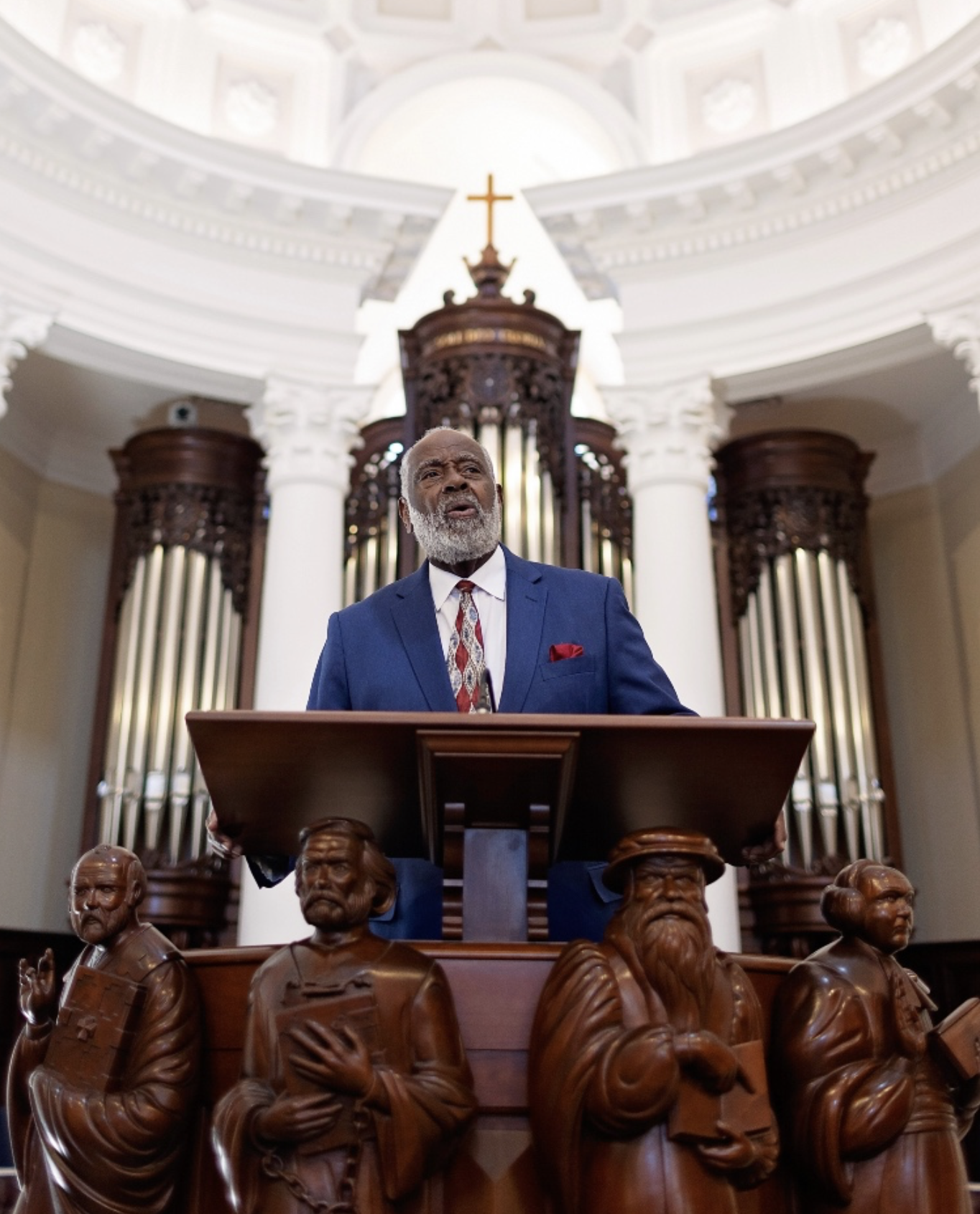
Dr. Robert Smith Jr. preaching in Andrew Gerow Hodges Chapel at Beeson Divinity School at Samford University
But Dr. Smith quickly put me at ease. His expectations for his students were high, and he did everything in his power to help us succeed. In the History of Women in Preaching seminar, the all-female class declared Dr. Smith to be an honorary woman because of his unwavering, compassionate support for us.
I preached the first sermon of my life in that seminar: “A Portrait of a Disciple,” based on the story of Tabitha found in Acts 9:36-42. When my father introduced himself to Dr. Smith a few years ago after hearing him preach at a church in Arkansas, Dad was delighted that the esteemed professor remembered his daughter. More than two decades after I preached in his class, Dr. Smith smiled and told my father, “I remember the sermon she preached on Tabitha.”
One evening in his class, as we talked about the art of sermon preparation, Dr. Smith emphatically declared, “Leave room for the Spirit!” In other words, while you are preaching, if the Spirit begins to move, be ready to stray from your carefully prepared manuscript. I laughed and responded, “I would prefer that the Spirit move while I am preparing!”
Dr. Smith’s words have been percolating in my heart and mind recently as I have reflected on how I prepare for and lead spirituality groups. As an Enneagram Type 1 who began to exhibit perfectionist tendencies in elementary school, I put significant pressure on myself to create meaningful group experiences. But is it really all up to me?
My graduation plaque from the Haden Institute
During my training at the Haden Institute to become a spiritual director, we were repeatedly urged by faculty members to remember that the Spirit of God accompanies us as we accompany others. We are not alone in our work. We do not have to rely solely on our own abilities. In fact, if we do, we will be ineffective spiritual companions.
Learning to trust the Spirit is an ongoing challenge for me. The old saying “Pray as if everything depends on God, and work as if everything depends on you” is not helpful to me, because I tend to focus on my side of the equation.
This year, whenever I have pulled out my enormous 3-ring binder brimming with resources to prepare for a Spirituality group, I have sought to be more mindful of the Spirit’s presence. As I consider what to teach in a particular session, I pray and ask the Spirit of God to guide me. What do the men at the Recovery Living Center at Costello House need most this week? What are the women at the Western Correctional Center for Women longing to hear?
In mid-February, as I prayerfully pondered my options for my next spirituality group at the women’s prison, a plan began to emerge. We would be meeting on the day after Ash Wednesday, so an explanation of Lent would be a natural starting point. From my binder, I extracted a handout I had created that would give the women a chance to consider what spiritual practice they might take on during the season, as well as what actions or attitudes they might choose to give up.
Where would we go from there? The Spirit brought to mind a conversation I had with a wise friend last year, a woman with vast experience leading spirituality groups. She had advised me that I could never talk about forgiveness too much. I turned to the “Forgiveness” tab in my binder and removed two handouts – one explaining what forgiveness is (and what forgiveness isn’t) and one featuring quotes about forgiveness.
What else? Recognizing that many of these women struggle to forgive themselves because of shame, I felt led to address that topic, too. Who do you turn to when talking about shame? Brené Brown, of course. I removed a tried-and-true resource downloaded from her website from my binder.
Was anything else needed? Whenever I talk about shame, I like to pair the subject with self-compassion. A handout adapted from Dr. Kristin Neff’s website was the final resource I pulled from my binder.

Sitting in a circle in the prison’s chapel on Thursday morning, I provided an overview of Lent and distributed the first handouts. After the women recorded their answers – what they might take on and give up during this holy season – I invited them to share their responses. The first woman to speak declared, “I want to give up shame and take on forgiveness.” I was stunned. Another woman echoed the first: “I need to work on forgiving myself. I have so much shame about what I’ve done.”
When everyone had finished sharing, I picked up the next two stacks of handouts. I explained that I had asked God to guide me as I prepared for this session; as a result, I had brought resources about shame and forgiveness. One woman exclaimed, “Well, look what God did!” Indeed.
As we were wrapping up our discussion of shame and forgiveness, one participant referenced a resource she had discovered on her tablet. The women all have access to prison tablets, which they use to communicate with family members and access curated educational and entertainment content.
“I found a self-compassion meditation on our tablets that has been very helpful to me,” she explained. “I can show you where to find it. The meditation is from Kristin Neff.” Again, I was stunned. I picked up my final stack of resources and said with a smile, “Well, here’s your last handout – a self-compassion meditation created by Dr. Kristin Neff.”
Well, look what God did.
As I drove away from the prison that day, I felt giddy and grateful. But why did I feel so surprised? This wasn’t serendipity. This was the Spirit.
“Leave room for the Spirit.” Thanks, Dr. Smith.