Bearing Witness
In February 2019, I intended to lead my sixth mission trip to Haiti. Anticipation had been growing, since this would be the first time youth would join adults on a journey intended to strengthen our congregation’s partnership with The Joseph School.
Three days before we were scheduled to fly from Nashville to Port-au-Prince, the U.S. State Department issued a “Do Not Travel” advisory for Haiti due to escalating violence. The four high school seniors who were slated to make the trip were deeply disappointed. I was, too.
Instead of traveling to Haiti, we hastily planned a civil rights road trip to Alabama for these seniors. Stops would include the Birmingham Civil Rights Institute, the Edmund Pettus Bridge in Selma, and the Legacy Museum and the National Memorial for Peace and Justice in Montgomery.
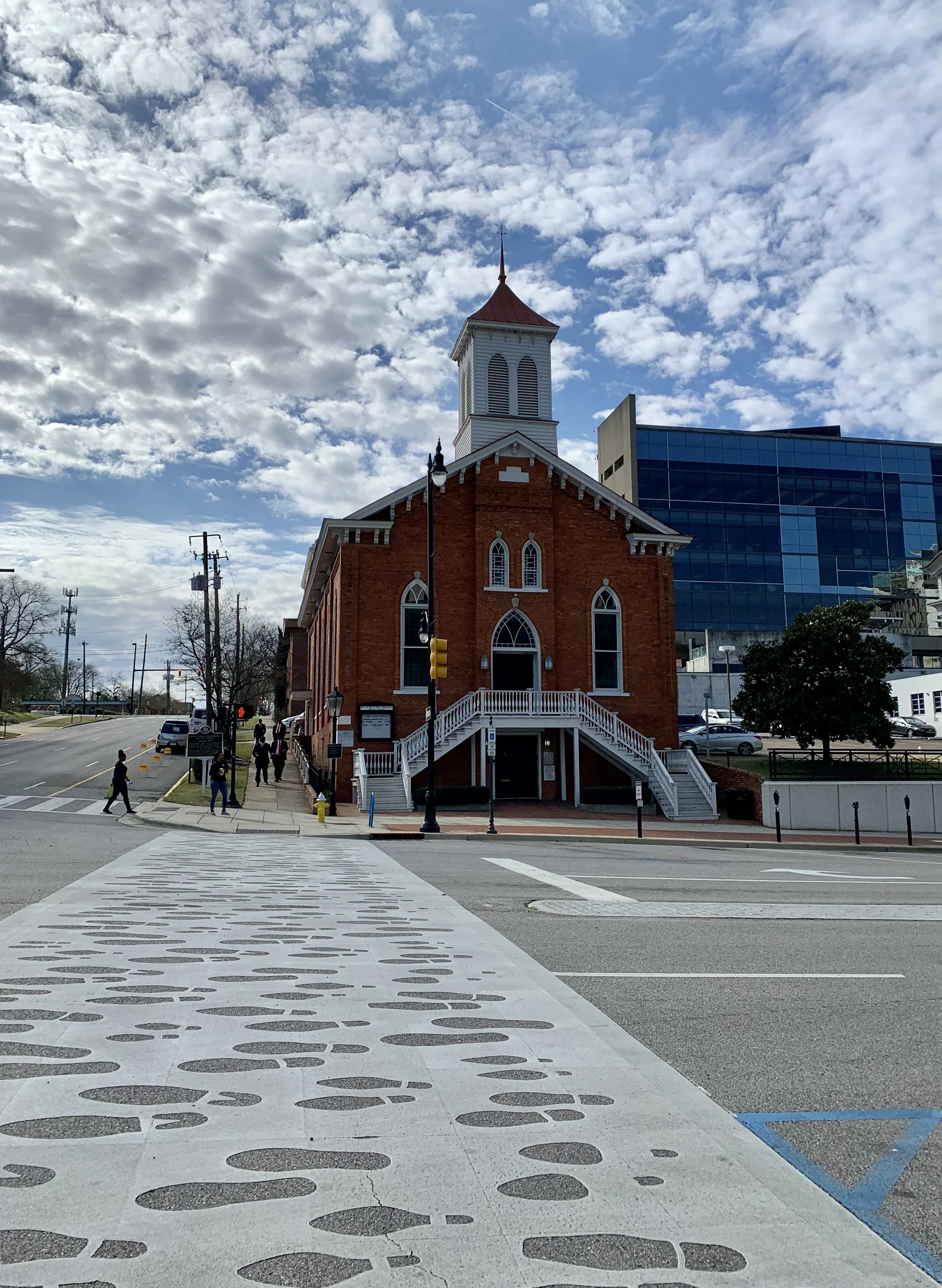
Dexter Avenue King Memorial Baptist Church and the Dexter Avenue Footprints in Montgomery, Alabama
On a sunny and warm Presidents’ Day in Montgomery, we decided to visit Dexter Avenue King Memorial Baptist Church, where Rev. Martin Luther King, Jr. served as pastor. We knew we would not be able to tour of the sanctuary that day, but we still wanted to see the site where the Montgomery bus boycott was organized. I had not realized this historic stop on the United States Civil Rights Trail was located only a block away from the Alabama State Capitol.
After taking photos of the exterior of the church, we walked across the Dexter Avenue Footprints. These symbolic footprints serve as a reminder of the brave protesters who marched 54 miles from Selma to Montgomery in 1965. That massive public demonstration - and the two unsuccessful attempts that preceded it - led to the adoption of the Voting Rights Act of 1965.
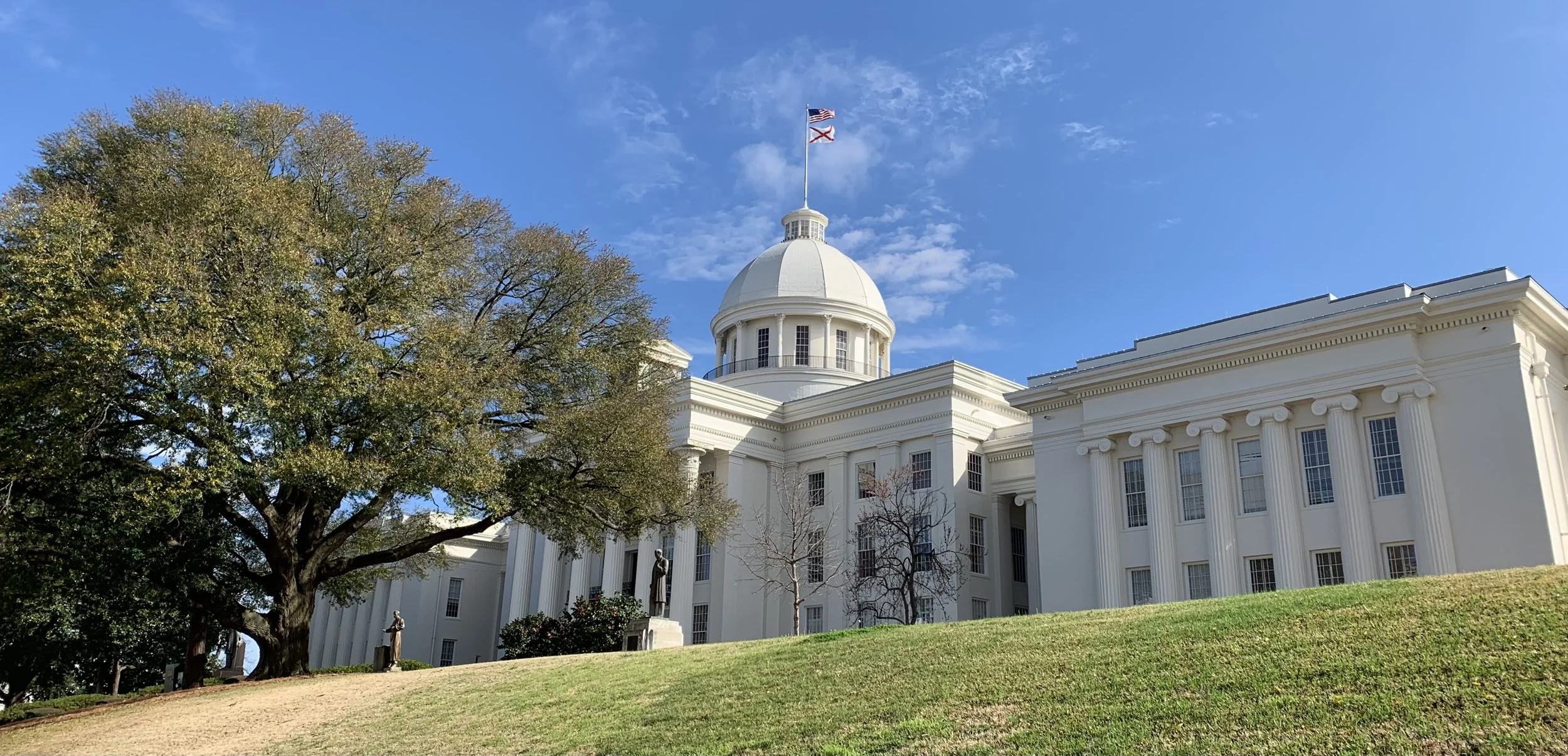
Alabama State Capitol in Montgomery
Before we climbed back into the church van, which was parked in front of the Capitol, the youth sprinted up the hill to investigate the monuments. When a student approached the statue closest to the van, I called out, “Who is it?” The teenager replied, “A geologist.” My husband, trailing the pack, paused at the statue underneath the sprawling oak tree, shook his head, and shouted a correction: “Gynecologist!”
Upon his return to the van, my husband reported that the statue honored a surgeon named James Marion Sims. The plaque on the monument proclaimed Sims to be the “Father of Modern Gynecology.” I had never heard of this doctor and was puzzled why a gynecologist would be lauded with a monument on the Capitol grounds. My curiosity turned to horror two hours later when we discovered another plaque referencing Sims, this one in the Legacy Museum.
Sims’s legacy is gruesome. While this plantation physician did develop methods that would save the lives of women in labor, research at his Montgomery practice was carried out on enslaved black women who were not afforded the luxury of anesthesia. (Sims believed that black people did not feel pain.) The more I read about Sims, the more appalled I was that Alabama continues to honor him with a memorial in front of the Capitol. (New York City removed a statue of Sims from Central Park in 2018.)
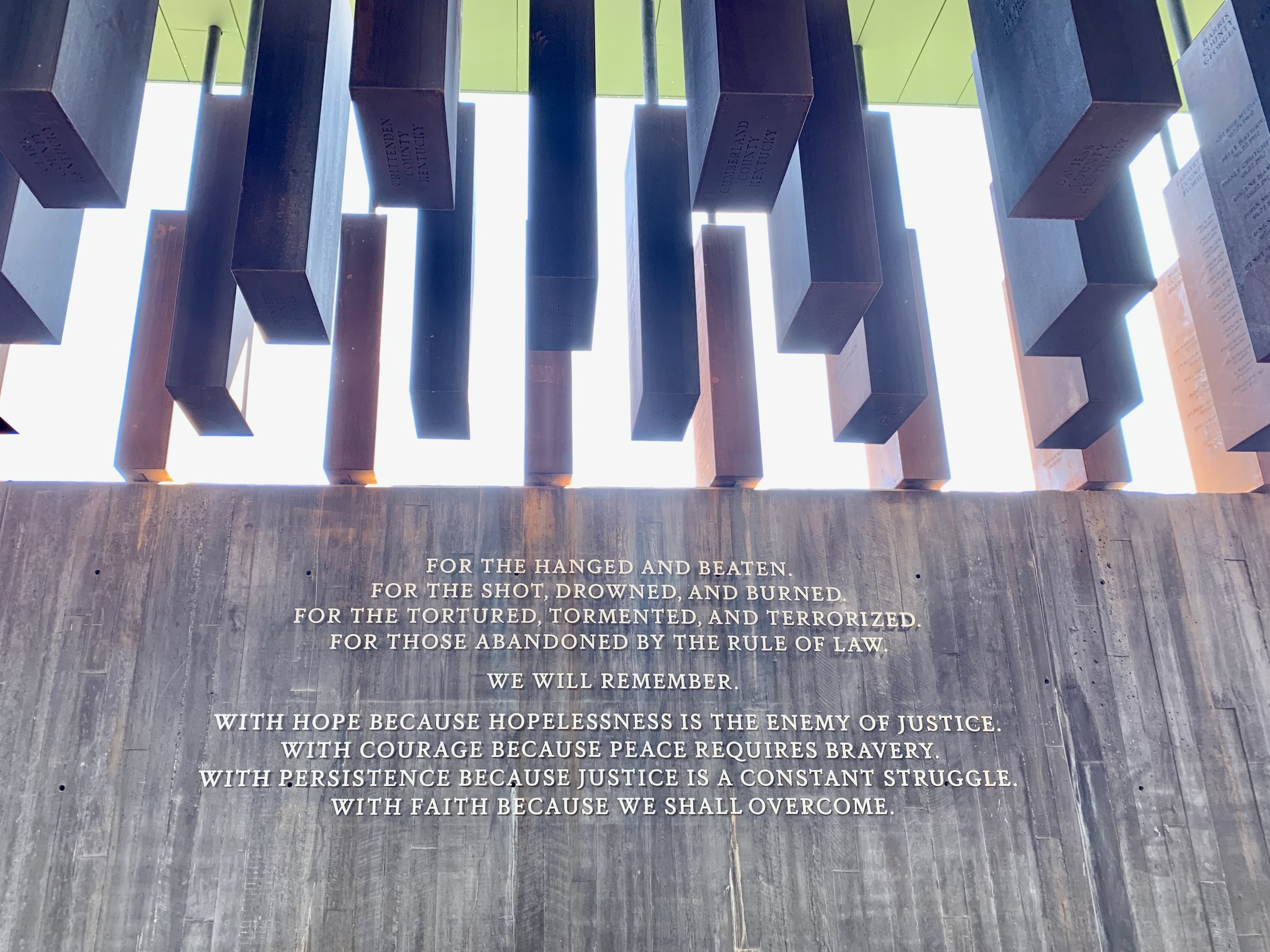
National Memorial for Peace and Justice in Montgomery, Alabama
Overwhelmed by all we learned at the Legacy Museum about the history of racial injustice in the United States, we soberly made our way to the National Memorial for Peace and Justice. At this heartbreaking site, art vividly reminds visitors of America’s horrific history of racial terror lynchings. The names of the more than 4,400 Black people who were lynched in the U.S. between 1877 and 1950 are engraved on more than 800 steel monuments, one for each county where a lynching took place. I sought out the monument for my county - Davidson - and read the names of four black men with a heavy heart. (Use the Equal Justice Initiative’s interactive map to research the number of lynchings that were carried out in your county.)
On the home page of The Legacy Sites, these words loom large: “The power of history is in telling the truth.” We are living in a distressing time in America where history is being whitewashed, where stories are being erased. In a blog post last week, historian Diana Butler Bass wrote about the necessity of bearing witness to bad news. Our ability to create a more perfect union is contingent upon our willingness to learn from the tragic truth of the past while bearing witness to the terrible truth of today’s injustices.
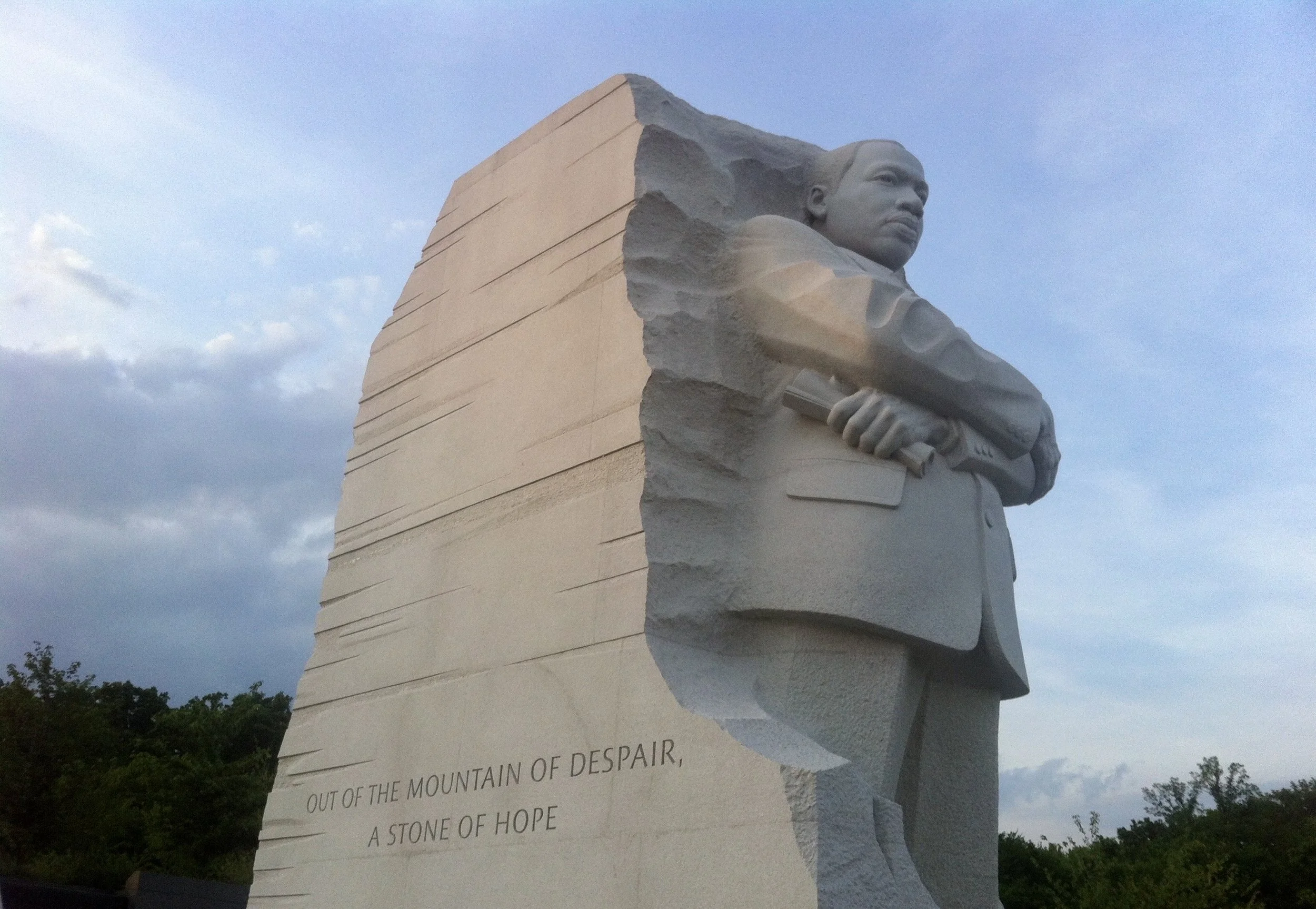
Martin Luther King, Jr. Memorial in Washington, D.C.
On this Martin Luther King, Jr. Day, I am remembering the things I learned on that civil rights road trip seven years ago. I am also recalling the words of a hymn my congregation sang yesterday during worship, “Let Truth and Mercy Find Here.” The final verse proclaims: “So now let peace and justice be never far apart, but flowing like a river for every thirsty heart. These two shall be united, a mighty moving stream, upon whose banks we gather to work and pray and dream.”
May it be so.
“Injustice anywhere is a threat to justice everywhere. We are caught in an inescapable network of mutuality, tied in a single garment of destiny. Whatever affects one directly, affects all indirectly.” - Rev. Dr. Martin Luther King, Jr.