LEFTOVERS
I preached this sermon based on Mark 6:30-44 on July 26, 2026, at Ecclesia Baptist Church.
Twelve years ago this month, I traveled to Haiti for the second time with a team from Nashville in partnership with The Joseph School. This non-profit was founded by my friend Jim Bryson in the aftermath of the devastating 2010 earthquake. Jim believed long-term change in Haiti could only be achieved through education, and he dreamed of establishing a Haitian-led school that would educate and empower the next generation of Haitian leaders.
Back in 2014, though, the school was still in the developmental stage. A perimeter wall and gate had been constructed and the foundation had been laid on Haiti’s Central Plateau. But a property dispute was brewing – a common occurrence in that country - and not long after our team returned to the States, the school’s construction ground to a screeching halt.
Our team visited that ill-fated property during our trip, but our primary purpose was to conduct a Vacation Bible School in a remote area near the Dominican Republic border. I confess I was more than a little bit anxious about this VBS, even though organizing Vacation Bible School every summer at my church was one of my responsibilities as associate pastor.
So many things were beyond our control in this setting. Our team really didn’t know what to expect when we left the guesthouse in Mirebalais and headed east into the Haitian countryside. What would the church look like? How many children would show up? Would there be enough translators? Did we bring enough supplies?
As the vans climbed a steep hill and came to a stop in front of a small, blue, two-room, rough-hewn church, I quickly took stock of our surroundings. Someone had thoughtfully stretched green tarps from the church’s corrugated roof to nearby trees to provide an additional shaded expanse where we could gather.
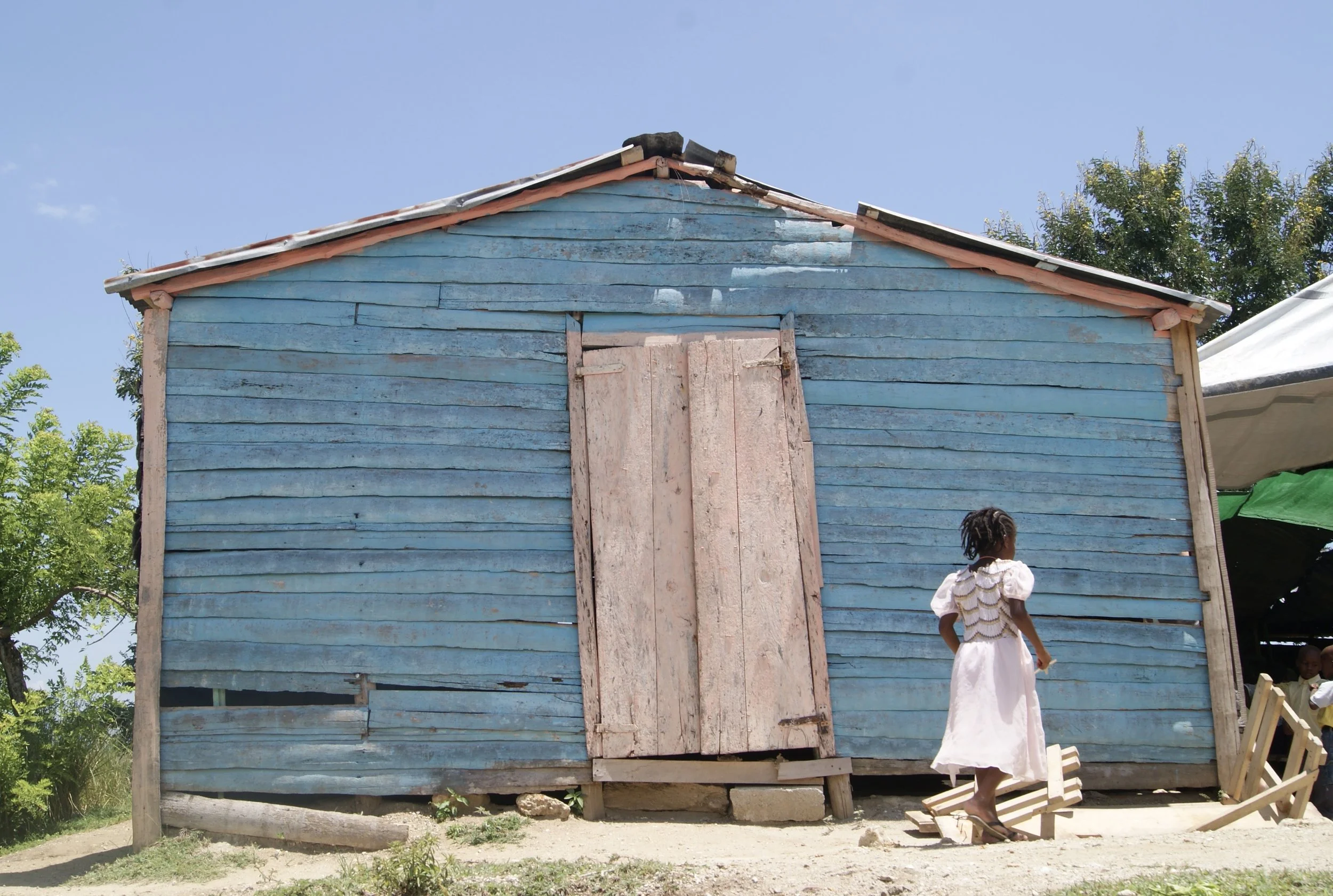
As we exited our vehicles, we laid eyes for the first time on the multitude that was waiting for us: over 100 children, plus a handful of adults, were seated outside the church underneath the tarps on wooden benches. The children had been eagerly anticipating our arrival.
We quickly unloaded our supplies and determined where the various activity stations should be set up: Bible story, recreation, crafts, and music. I would be leading the Bible story rotation in the dirt-floored room that the congregation used as their sanctuary – with the much-needed help of a translator. After we got organized, Pastor Remy led the children in song and prayer and then entrusted them into our care.
That July morning was sweltering, even by Haitian standards. When the temperature crossed the 100° mark, the recreation group abandoned their soccer game - even the Haitian children were too hot to play. After we wrapped up our VBS rotations, Pastor Remy asked us to fill more time, because lunch wasn’t quite ready.
I was aware that some of the money we had paid to The Joseph School to participate in this trip would be used to feed the children after each VBS session. Half of Haiti’s population is malnourished, so meeting the children’s physical needs was a priority. But I had not considered the mechanics of the meal. We were in a two-room church. There was no kitchen. No Fellowship Hall. No electricity. No running water.
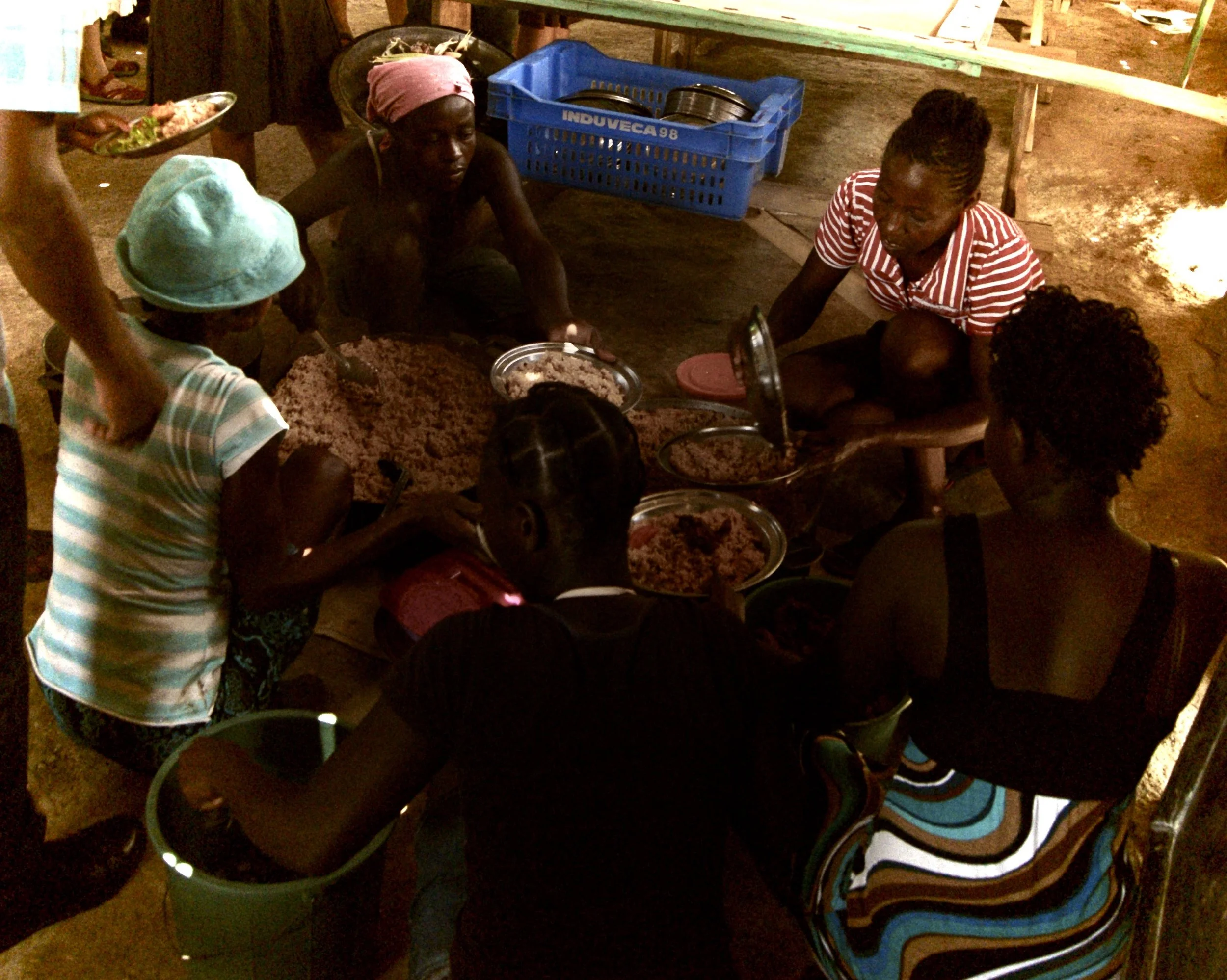
While our American mission team had been leading VBS that morning, a handful of hard-working Haitian women had been cooking a meal for the multitude over an open fire in a shack down the hill from the church. Suddenly, those women appeared, lugging huge cast iron pots of rice and okra sauce into the church. The room where I had been teaching was hurriedly converted into a makeshift kitchen. Someone carried in a stack of large tin plates, reminding me of the ones that miners use when panning for gold.
The women squatted beside the pots and commenced serving. One scooped a heaping helping of rice onto each plate. A second used a ladle to drench the rice with okra sauce. A third crowned each mound with a small cube of meat.
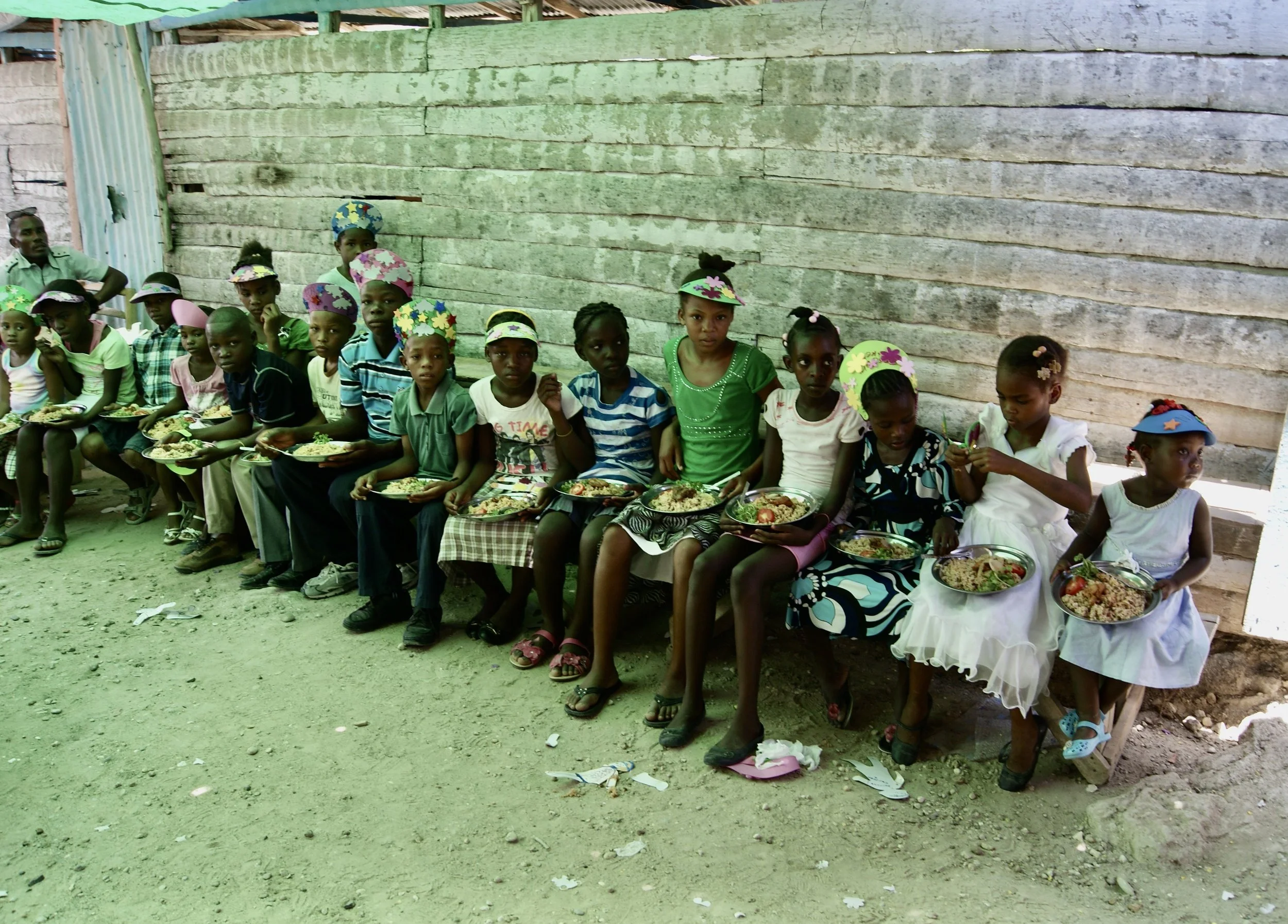
We took turns carrying the filled plates out to the children, who were sitting side-by-side with no elbow room on the benches beneath the tarps. They waited patiently to be served, then waited patiently with hot plates on their laps for the signal to begin eating. We Americans marveled at the sight. Many of these children were desperately hungry – this would be their only meal of the day. Yet they waited without complaint.
When finally given the signal to eat, the children did so eagerly, quickly cleaning their plates. Older children spoon-fed younger siblings before beginning to eat their own meals. “And all ate and were filled” (Mark 6:42). A blessed meal.
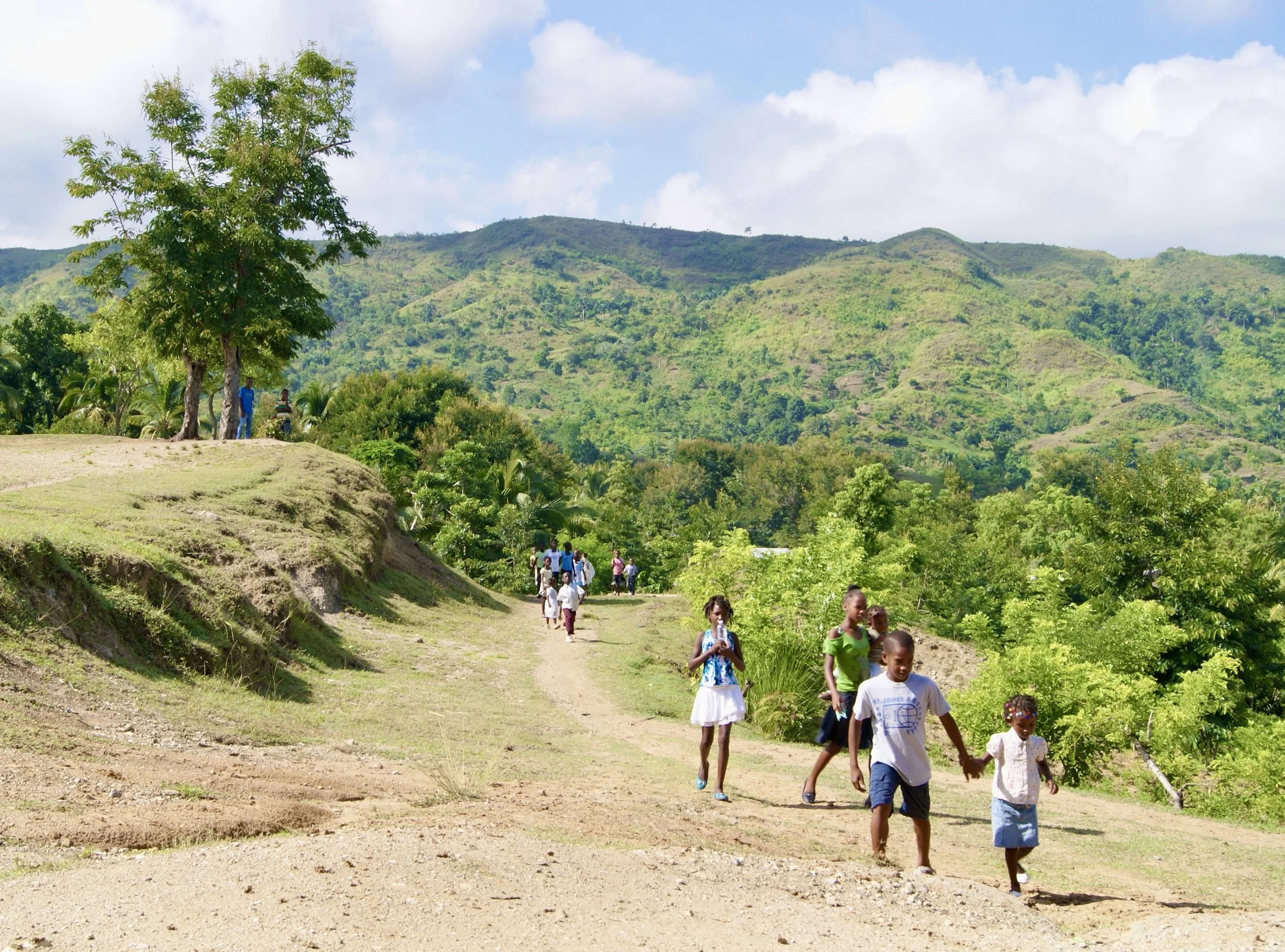
The next morning, we arrived at the church a bit earlier. The multitude was still assembling as we disembarked from the vans. We would teach and feed an even larger crowd that day – at least 140 children. As I watched the girls and boys approaching, walking hand in hand over the hills along dirt paths, older children carrying younger siblings on their hips, I felt as if I had been transported to a hillside in Galilee. “Jesus saw a great crowd, and he had compassion for them” (Mark 6:34). How could we not have compassion for these precious children?
The title of the Bible story for the second day of VBS was “The Boy Who Shared his Lunch.” I read Ella Lindvall’s version to the children from her collection of Read-Aloud Bible Stories: “Up, up, up the big hill went Jesus, up the big hill. Up, up, up went Jesus’ friends, up the big hill.”[1] For the first time in my life, I felt as if I were completely immersed in a sacred story from Scripture.
But even as I recounted to the children how Jesus had miraculously turned five small loaves of bread and two small fish into a feast sufficient to feed a multitude, I wondered if we would have enough food to serve at lunchtime because of the additional influx of children. But once again, the resources were assembled, the women labored over a hot fire, Pastor Remy prayed, and the mission team distributed the food. God provided. And there were leftovers. Another blessed meal.
That evening as our team reflected on our experiences, my friend Melanie observed that she had felt as if she were serving communion when she distributed the plates of food to the children. On a hillside in Galilee, Jesus took “the five loaves and the two fish, looked up to heaven, and blessed and broke the loaves, and gave them to the disciples, and the disciples gave them to the crowds” (Mark 6:41). In an upper room in Jerusalem, “Jesus took a loaf of bread, and after blessing it he broke it, and gave it to the disciples, and said, ‘Take, eat; this is my body’” (Matt. 26:26). The body of Christ. We had been the body of Christ on that Haitian hillside when we served the children in Jesus’ name.
On that first century day in Galilee when the multitude gathered on the shore to hear Jesus teach, his disciples recognized the needs of the people, but they failed to see how they could meet those needs. When the disciples asked Jesus to send the people away to find food, Jesus replied, “You give them something to eat” (Mark 6:36). Jesus knew that in God’s economy, the resources to meet the people’s needs could be found among the people.
Back in the ‘90s, in the early days of the Food Network, I enjoyed watching a show called “Gordon Elliott’s Door Knock Dinners.” The show’s premise was simple: Elliott would arrive unannounced on someone’s doorstep, with a gourmet chef in tow. Using only the ingredients found in the resident’s fridge, freezer, and pantry, the chef would create a gourmet meal for the resident and their neighbors. I was fascinated by this show, since I sincerely doubted that a chef who knocked on my door would be able to conjure up a gourmet meal with the meager offerings available in my kitchen.
I can sympathize with the disciples who were flummoxed by Jesus’ directive to feed the crowd. Can you picture them sheepishly roaming around among the people on the hillside asking, “Excuse me, you didn’t happen to bring any food, did you?” I can feel Andrew’s anxiety when he reports back to Jesus that he has located a boy who has five barley loaves and two small fish: “But what are they among so many people?” (John 6:9).
Jesus is unphased. He begins to give instructions to facilitate the mass feeding. This story is traditionally called the feeding of the 5,000, but all four gospel writers specify that the number refers only to the men in attendance. Women and children were most assuredly present, too, so a conservative doubling of that number puts the crowd at the size of the one that gathered in Madison Square Garden for Taylor and Travis's wedding earlier this month.
After the disciples subdivide the crowd into more manageable groups, Jesus takes the loaves and the fish, blesses them, breaks them, and gives them to his disciples to distribute to the people seated on the grass. Miraculously, there is enough food for everyone to eat and be satisfied. In fact, there is more than enough. Afterwards, the disciples collect 12 baskets of leftovers so that nothing is wasted.
What really happened during this marvelous meal, the only miracle that is recorded in all four gospels? What does the scene look like in your imagination? Some commentators have suggested that after the little boy shared his lunch with Jesus, other folks in the crowd felt compelled to share the food they had brought with them. Thus, the supply of food was multiplied through the generosity of the crowd, not because Jesus used divine power to fill and refill the baskets.
Other folks have vehemently rejected such an interpretation. If the people just shared their own food, they argue, then this wasn’t really a miracle. They assert there’s nothing supernatural about people combining their resources and redistributing them. In an era where self-centeredness and greed are regularly on display in the news, I would argue that neighbors choosing to help neighbors is indeed supernatural, a Spirit-led endeavor.
Now I don’t pretend to know exactly what happened that day on the shore when Jesus looked with compassion on the multitude, when the One who called himself the Bread of Life made sure that hungry people had bread to eat. I do believe some sort of miracle unfolded.
When my husband Paul and I taught preschool Sunday School together early in our marriage, the story of the feeding of the 5,000 appeared with regularity in the curriculum. Looking back, I am aware that the focus of those lessons was almost always exclusively on the boy – the child who is only specifically mentioned by John. This was the curriculum’s core message: See how the little boy shared his lunch? God wants you to share, too.
In her thought-provoking book Woven: Nurturing a Faith Your Kid Doesn’t Have to Heal From, pastor Meredith Anne Miller offers advice to parents and grandparents and anyone else who seeks to help children draw closer to God. Instead of making every Bible story a morality lesson – “Do what that person did” or “Don’t do what that person did” – Miller instead urges us to pay close attention to what a particular story teaches us about the nature of God. What does the story reveal about God’s character? What does the story teach us about God’s love and compassion?
“You give them something to eat,” Jesus told his disciples as they stood in front of a famished crowd (Mark 6:37). Jesus’ instructions emanated from a heart overflowing with compassion for the hungry and the hurting, the lost and the lonely. Jesus clearly saw the needs of the people, and he invited his disciples to look at them through the same compassionate lens.
As the Church, the body of Christ in this world, we have a God-given invitation to join God in the feeding and healing and loving of our world. As Paul wrote in one of his letters to the church at Corinth, “We are God’s coworkers” (1 Corinthians 3:9).
May we faithfully and creatively work together as the body of Christ to create a world where no one is left out and there are always leftovers.
[1] Ella K. Lindvall, Read-Aloud Bible Stories: (Chicago: Moody Publishers, 1987).