Daughter
Below is the text of the sermon I preached at the Western Correctional Center for Women in Swannanoa, North Carolina, on Sunday, July 5, 2026. The sermon is based on Mark 5:21-43.
Two years ago, I read a troubling and infuriating book called All in Her Head, written by Elizabeth Comen. The long subtitle of this book is The Truth and Lies Early Medicine Taught Us About Women’s Bodies and Why it Matters Today. Dr. Comen is an oncologist who specializes in treating women with breast cancer. As you can tell from the title of the book, she is also a medical historian.
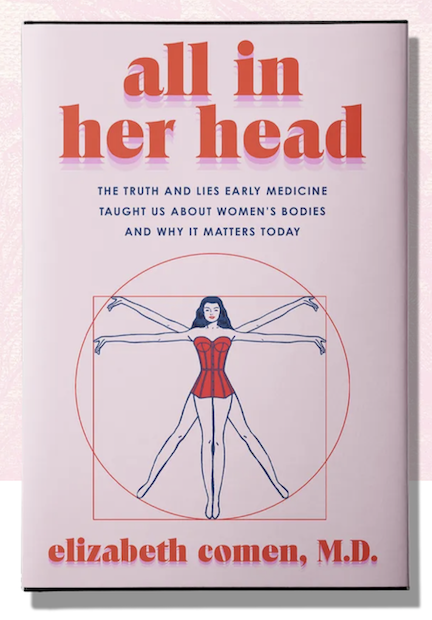
In this shocking and heartbreaking book, each chapter focuses on a different system within the human body: integumentary (skin), skeletal, muscular, circulatory, respiratory, digestive, urinary, immune, nervous, endocrine (hormones), and reproductive. Now, why have I described this book as being troubling and infuriating, shocking and heartbreaking? Because in these eleven chapters, Dr. Comen highlights how throughout the history of medicine, women’s bodies have been treated like objects to be practiced on, and women’s voices have been ignored or dismissed. As a result, women often feel ashamed when they seek medical attention, and they tend to discount own their suffering.
“It’s all in her head.” Perhaps you have heard that phrase uttered by a doctor when you accompanied a loved one to an appointment. “It’s all in your head.” Perhaps a doctor has spoken those words directly to you, as he condescendingly explained that your symptoms weren’t real or your complaints were exaggerated.
The woman who had been bleeding for twelve years knew her symptoms were real – her suffering was certainly not all in her head. Yet the medical “professionals” she had consulted for over a decade had repeatedly failed her. According to Mark, this woman had been under the care of many doctors through the years. She had spent all her savings on medical care, but she had gotten worse, not better. How exhausting. How frustrating. How heartbreaking.
Did you notice the contrast between the descriptions of the man and the woman in the story from Mark’s Gospel? Here’s what we know about the man who sought Jesus out on the lakeshore. His name was Jairus. He was a local synagogue leader. His house was located near the lake. He had a wife and at least one child – a 12-year-old daughter who was dying.
What do we know about the woman who made her way through the crowd to get close to Jesus on the lakeshore that day? Well, we don’t know her name. We don’t know how she managed to save money of her own to spend on medical care. We don’t know how far she travelled to see Jesus. We don’t know if she had a family.
Jairus was powerful, wealthy, and privileged. The unnamed woman was powerless, poor, and vulnerable.
What we do know about these two desperate people who sought Jesus’ help – one on behalf of his daughter and other for herself – was that they both had faith that Jesus possessed the power to heal the human body.
Jesus had arrived on this beach after dramatically healing a man on the opposite side of the lake, a man who was said to have been possessed by a legion of demons, but that was not the first time he had cast an evil spirit out of a man. Jesus had also healed a man with a shriveled hand, as well as a paralyzed man. He had healed Simon’s mother-in-law, who had been bedridden with a fever.
Word had quickly spread that a new healer was on the move in Galilee. No wonder crowds were following Jesus around as he travelled from village to village, preaching the good news of the kingdom of God. No wonder people who were suffering were seeking Jesus out, hoping to be healed.
Jairus’s quest to get Jesus to come to his house to lay healing hands on his dying daughter was interrupted by this unnamed woman’s secretive mission. Now here’s another contrast in the story. Jairus was very public about his needs, dramatically falling at Jesus’ feet, pleading with him to come and heal his daughter. This woman, though, was content to remain invisible. She didn’t feel the need to speak to Jesus. Her faith was so great that she believed if she could just touch Jesus’ clothes, she would be healed.
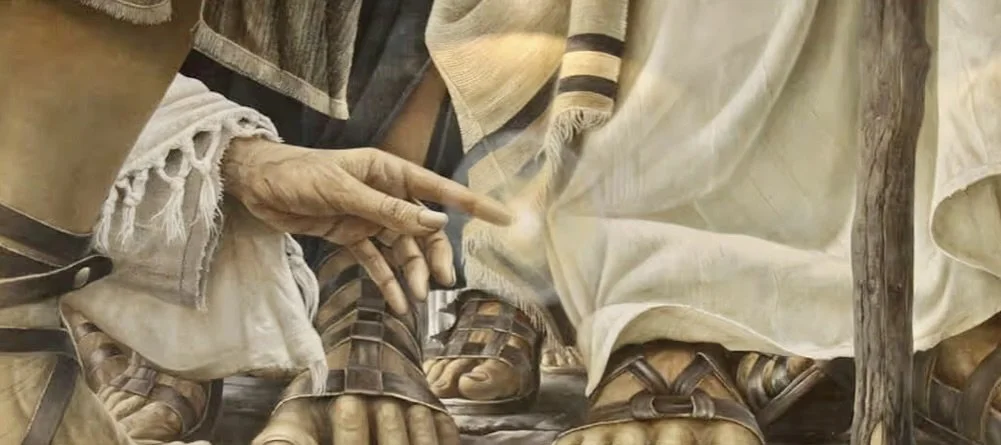
Encounter by Daniel Cariola, mural in The Encounter Chapel in Magdala
The woman’s desire to remain anonymous was likely rooted in the cultural implications of her physical condition. Because of her abnormal bleeding – far beyond what would be expected with a normal monthly cycle – she was considered to be ceremonially unclean under Jewish law. Why does that matter? It matters because while she was bleeding, she was unable to enter a sacred place or participate in community worship. Because many people believed uncleanliness was contagious – meaning you could become unclean if another unclean person touched you or even entered the room you were in – people who were deemed unclean were expected to isolate themselves.
In ordered to be regarded as clean, this woman’s flow of blood would need to stop for at least seven days. Now how often during those twelve long years of suffering had the woman achieved “clean” status, we do not know. We might suspect from the way she stealthily crept through the crowd to touch Jesus that she may very well have been bleeding at that very moment of contact. She didn’t want to be the object of public scorn, feared for a condition that was beyond her control. But she also didn’t want to spend another day suffering.
The woman executed her plan to perfection. As Jesus was making his way through the crowd to Jairus’ house with the panicked father at his side, she was able to come up behind him, stretch out her hand, and brush her fingers against his cloak. Her bleeding stopped immediately. She knew in that holy moment that her body had been healed. Finally. Relief.
But the woman wasn’t the only person who recognized that something miraculous had happened. Jesus stopped in his tracks. He turned around, surveyed the crowd, and asked, “Who touched my clothes?” His disciples thought this question was absurd: “People are pushing you from every side.” But Jesus knew that divine power had been transferred from his body to someone else’s body, and he wanted to know who had been healed.
At this point, the woman felt obligated to identify herself. Trembling with fear, she knelt humbly in front of Jesus, just as Jairus had done moments before. I suspect that her fear was directed toward the crowd that might shame her rather than Jesus who healed her. The woman bravely told Jesus the whole truth of why she touched him. She entrusted him with her story of suffering. I imagine her voice grew stronger as she shared her testimony, especially when she recounted the instant she felt that surge of healing power as she touched Jesus’ clothing.
After the woman finished telling her story, Jesus spoke a word that must have caused her heart to sing: “Daughter.” When was the last time she had heard that word so tenderly spoken? Were her own parents still alive? Had her father once been her advocate, helping her to access medical care, the way Jairus had advocated for his daughter? Or as the years had passed and her hemorrhaging had continued, had her father become embarrassed by her unclean condition? Had he lost faith that healing was possible for her?
“Daughter,” Jesus declared, “your faith has healed you; go in peace, healed from your disease.” As people pressed against him on every side, as a frightened father and puzzled disciples looked on, Jesus publicly affirmed this unnamed woman. Her faith in Jesus led to her healing by Jesus.
But it’s worth remembering that her healing had not been a quick fix. This woman had waited a long time – twelve years! During that span, she had undoubtedly whispered countless prayers, had shed innumerable tears. This woman had endured relentless suffering before her healing encounter with Jesus. At the end of this story in Mark’s Gospel, this child of God, this beloved daughter, body healed and faith affirmed, could go in peace.
Daughters. Sons. Beloved children of God, tonight I bring you the good news that you are not alone in your suffering. God knows your story. God doesn’t only care about the state of your soul. God cares about the health of your body and your mind and your spirit.
When I think about this story of the bleeding woman, I am mindful that not all such stories have a happy ending. I suspect that every person in this room could share a story tonight about a loved one who suffered but did not experience the desired physical or mental healing they sought, even though they prayed to be healed, even though others prayed for them to be healed, even though they had faith, even though their family and friends had faith.
Nevertheless, I take comfort in knowing that God is with us as we suffer, and God can help us make meaning in the midst of our suffering. The bleeding woman was not defined by her disease. She was defined by her persistence, her courage, and her faith.
With God’s help, we can learn to reframe our stories of suffering. We can learn to see ourselves as God sees us, as beloved children whose pain is witnessed. We can know God as an ever-present, loving force in our own sacred stories, the One who empowers us to go in peace, despite our suffering.
Daughters. Sons. Children of God. You are loved by God. You are known by God. May you experience the healing you seek. Amen.