Olympic Inspiration
Last weekend, I watched sporting events I only view at four-year intervals: curling, freestyle skiing, speed skating, figure-skating, snowboarding, ski jumping, cross-country skiing, luge, alpine skiing, and ice hockey. As I acquainted my grandson with the various sports featured in Saturday’s broadcast of the XXV Winter Olympic Games, I pointed out the tiny flags that appeared on the screen beside each competitor’s name. In the process, my mind drifted back to the 2018 Winter Olympics.

On Wednesday nights during that season of my life, I led a weekly Children on Mission group at the church where I served as associate pastor. Finding games that worked well in a setting that included kindergartners through sixth graders was always a challenge. Inspired by the Winter Olympics, I created a team-based matching game featuring flags of participating countries.
After identifying flags with simple designs and a maximum of three colors, I went to work with 11” x 14” sheets of foam board and rolls of red, yellow, blue, green, and white duct tape. I was inordinately proud of the resulting matching pairs, which included France, Italy, Austria, Netherlands, Denmark, Finland, Sweden, and Switzerland.
While most of the children were enthusiastic participants, one kindergartner was not a fan. When I arranged the flags face-down on the classroom floor, her eyes filled with tears. The first time this happened, I thought I was witnessing a manifestation of her shyness. The second time, I realized her tears were connected to her perfectionist tendencies: She didn’t want to play the game because she feared she would not be able to make a match.
As a fellow perfectionist, I knew I was in no position to judge this sweet child. My own perfectionism, which manifested itself early in my childhood, has been a lifelong barrier that has hindered me from taking risks and exploring possibilities. If I did not believe I could do something well, I did not even want to try. I know I have missed out on opportunities that had the potential to enrich my life and broaden my horizons; my fear of failure has undeniably been limiting.
A friend of mine loves to pose a version of this question at dinner parties: If you knew you could not fail, what would you do? One summer I made it a point to ask several children this question. The first child, a precocious 9-year-old boy, did not have to think twice before answering, “I would climb Mount Everest.” His wise father posed a follow-up question: “What would it look like for you to climb Mount Everest and not fail?” The child explained, “Well, I would summit Mount Everest, and I wouldn’t lose anything on the way up or down, like a glove or a climbing partner.”
A few weeks later, when I asked an 8-year-old girl the same thing, she exclaimed, “That’s a hard question!” After pondering her options, she declared, “I would bake an apple pie.” I suppressed a laugh, surprised by the simplicity of her response, but I soon realized the apple pie was a part of a bigger dream – this child wanted to have her own cooking show.
My finally respondent, an 8-year-old boy, also pronounced the question to be difficult. After a minute, a broad smile spread across his face as he announced: “I would go to Dave & Buster’s!” The allure of winning every game in the arcade filled his heart with glee.
Watching this winter’s Olympians, I wonder how they would have answered that question as children. I suspect many of them harbored big dreams from an early age. But failures would be unavoidable as they trained in hopes of transforming their dreams into reality. No competitor makes it to the Olympic Games without suffering pain and disappointment, injury and loss.
This year, I find I am not particularly interested in which flag appears beside a competitor’s name. I am not keeping tabs on the medal count. I am, however, keenly interested in the athletes’ stories.
I was delighted when speed skater Francesca Lollobrigida won Italy’s first gold medal of the Milan Cortina Olympics, breaking the Olympic record in the women’s 3,000m on her birthday as her husband and 2-year-old son cheered her on in the arena.
I was similarly pleased when the crowd at the Tesero Cross-Country Skiing Stadium enthusiastically celebrated with the 25-year-old competitor who finished 64th in the men’s skiathlon. Stevenson Savart, Haiti’s first Olympic cross-country skier, did not win a medal, but he won the hearts of millions.
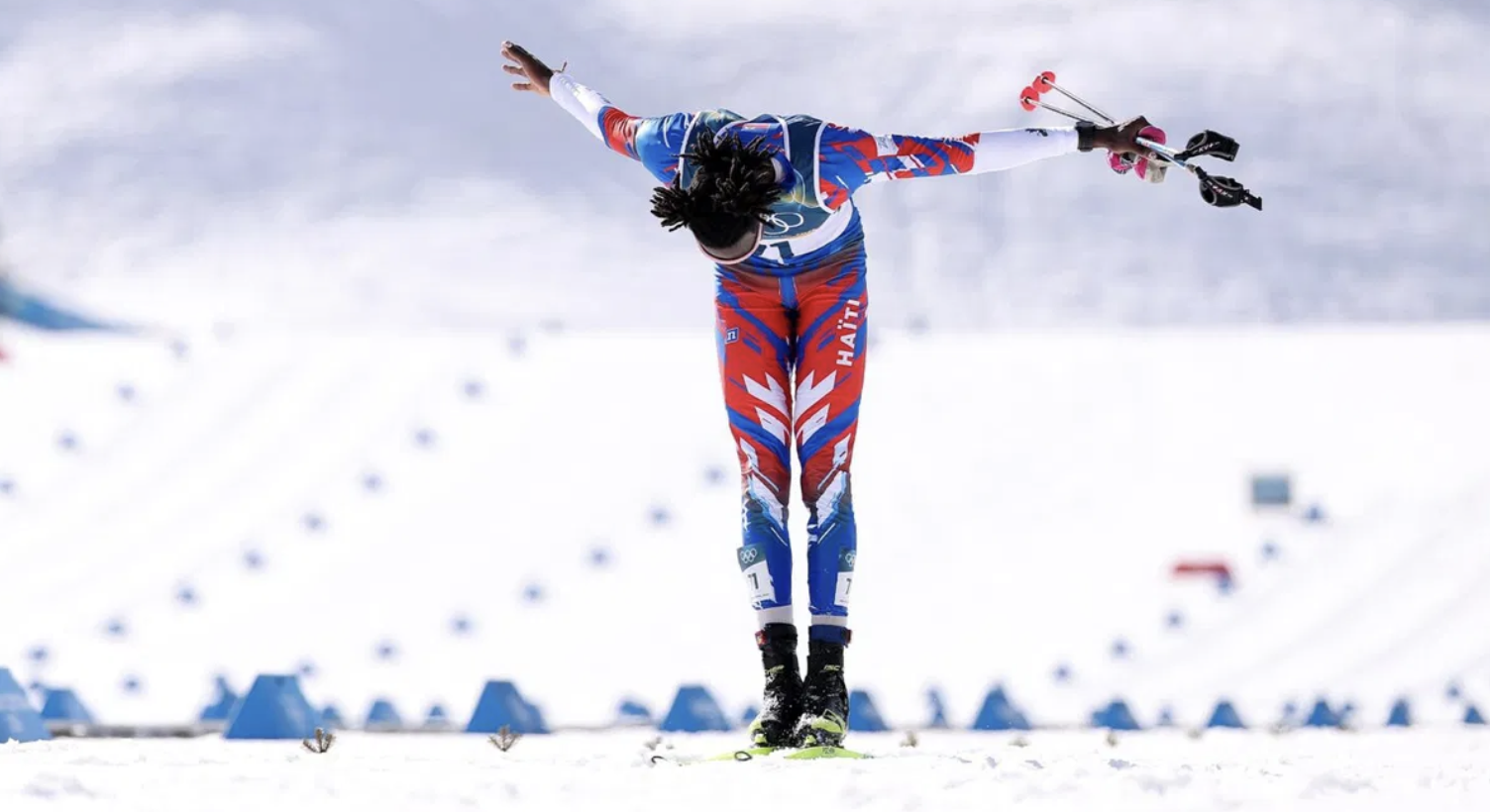
Stevenson Savart takes a bow
If you knew you could not fail, what would you do? If you knew you would fail repeatedly in your quest for success, would you still try? What are you learning from the athletes of the 2026 Olympic Games?